For clinicians and organizations
When the plan is sound but mealtimes aren't moving.
Referral, clinical consultation, and team education for professionals supporting children 0–7 with feeding and mealtime challenges. Built on The Regulated Table™ Framework: regulation first, then skill.

Refer a family
Refer when nutrition or medical guidance is appropriate but implementation stays stuck, especially when you suspect one of the 5 Feeding Driver Patterns is limiting it: Regulation, Sensory, Feeding Skill, Rigidity, or Environment.
No physician referral or diagnosis is required. Families in every Canadian province except Quebec are eligible. Services are not available in the territories. Alberta FSCD-funded families are welcome; funding and billing questions go to our admin team.
The Regulated Table™ Framework
The 5 Feeding Driver Patterns. One question.
A feeding plan can be clinically appropriate and still be unusable for this child and this family. Every consultation and referral works from the same question: which drivers are limiting the plan, and which one leads?
- RegulationProfile: Dysregulated Feeder
- The child's nervous system state at the table. The body can't settle enough to eat.
- SensoryProfile: Sensory Explorer
- How taste, texture, smell, and temperature are processed.
- Feeding SkillProfile: Skill Builder
- Oral motor function: chewing, tongue movement, and swallow coordination.
- RigidityProfile: Predictability Feeder
- A need for sameness. Accepted foods drop off when anything changes.
- EnvironmentProfile: Environmental Feeder
- Routines, pressure, caregiver stress, and the relationship around meals.
Drivers are ranked as primary, secondary, or contributing. The leading driver decides the next step.
Clinical consultation
For dietitians, OTs, SLPs, psychologists, and interdisciplinary teams with a case where the plan makes sense but progress has stalled. Stephanie works through the case with you to identify what is actually driving the feeding picture and what to try next.
Send a de-identified case summary
Age, presentation, what's been tried, relevant assessment findings, and where it's stuck. Mealtime video is welcome with caregiver consent.
Work the case together
A virtual consultation to identify the dominant drivers, competing hypotheses, missing information, and scope or referral considerations.
Leave with a next clinical experiment
A brief written summary of the working hypothesis, the next step to test, and what to watch for at review.

One-to-one case consultation
One clinician, one case. Suited to a single stuck case or a second opinion before changing course.
Clinical rounds for teams
Your team brings one to three cases. Stephanie facilitates case-based reasoning across disciplines, so the team leaves with a shared approach.
Scope of consultation
- Consultation is advisory. The treating clinician retains clinical responsibility for the client.
- Case information is shared de-identified. ITS does not contact the family.
- If the child needs direct OT assessment or intervention, a referral is discussed separately.
Requests go to our admin team, who confirm fees, availability, and scheduling.
Workshops and team education
Regulation-first feeding education designed around your setting: in-services and lunch and learns for clinical teams, physician offices, and pediatric clinics, and parent workshops hosted by daycares and community organizations. Every professional session includes a referral pathway your team can keep using.
Talks
- When feeding strategies aren't landing: Safety, Regulation & Readiness in Pediatric FeedingDietitian team in-service · October 2026
- Supporting Your Neurodiverse Child at Mealtimes: Simple Steps to Reduce Stress & Build Positive Feeding ExperiencesWebinar for an Airdrie community parent group · September 2025
- Feeding Therapy Lunch & LearnBump Birth & Beyond clinicians · June 2025
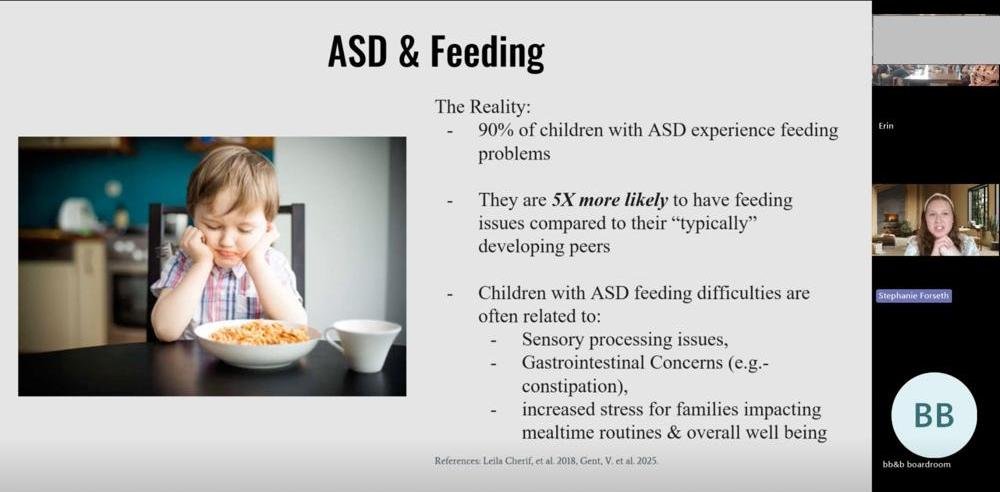
- ASD Parent NightBump Birth & Beyond · May 2025
- Supporting Student Regulation: Practical Takeaways to Support Our Students with Regulation in the ClassroomSiksika Board of Education staff in-service · February 2023
- Sensory Smarts: Effective Ways to Support Diverse Sensory Needs Within Our ClassroomsBlackfoot Confederacy Conference · October 2022
- Getting in the Zone: Practical Takeaways to Support Our Students with Self-Regulation in the ClassroomBlackfoot Confederacy Conference · October 2022
Past engagements include the Blackfoot Confederacy Conference, Siksika Board of Education, and Bump Birth & Beyond.
Help decide what's built next
ITS is developing new ways to support clinicians and teams. Choose the options you would use. Your answers shape what gets built first, and you'll hear first when something opens.
Opens a short survey. Please don't include client or case details.